Scan the QR code to follow us on WeChat.

We have provided
4000000
sets of ICT high-efficiency cooling and free cooling products to the world




Thank you for your interest
in our affiliated companies

As China continues to advance its dual-carbon goals of carbon peaking and carbon neutrality, and as PUE requirements for data centers become increasingly stringent, legacy telecommunications equipment rooms (TERs) have become a key focus for energy conservation and emissions reduction.
A systematic energy-saving retrofit project at a telecommunications operator's data center in Guangxi, China, leveraging Envicool's energy efficiency retrofit solution, has delivered remarkable results: average annual PUE has been significantly reduced, overall energy savings have exceeded 40%, and the expected payback period is only around three years - establishing a benchmark for green transformation of regional communications infrastructure.
Retrofit Background: High PUE Highlighted the Need for Urgent Efficiency Improvements
The building of the telecommunications operator's data center comprises 17 active TERs primarily by aging fixed-speed units. As business loads grew and electricity costs rose, the original cooling model revealed structural bottlenecks:
Compressors operated under high load for extended periods
Insufficient utilization of natural cooling during transitional seasons;
Hot and cold air streams mixed together, leading to wasted cooling capacity;
• Fixed-speed units could not adapt to varying loads across different climate conditions;
Multiple units operated independently, often working against each other and driving up energy consumption.
Survey findings revealed that the average annual PUE of the facility had significantly exceeded the national guideline of PUE < 1.5 — indicating that the challenge extended beyond aging equipment and reflected broader system-level inefficiencies..
Based on this assessment, the Envicool team did not adopt a simple "replace old with new" approach. Instead, ourteam first conducted an energy efficiency audit — including a 72-hour rapid diagnosticassessment -covering on-site inspections and systematic evaluation across three key dimensions: cooling source, airflow, and control. The final solution centered on three key measures- pneumatic heat pipe technology, cold aisle containment, and AI-powered group control-with 46 air conditioning units replaced in phases.
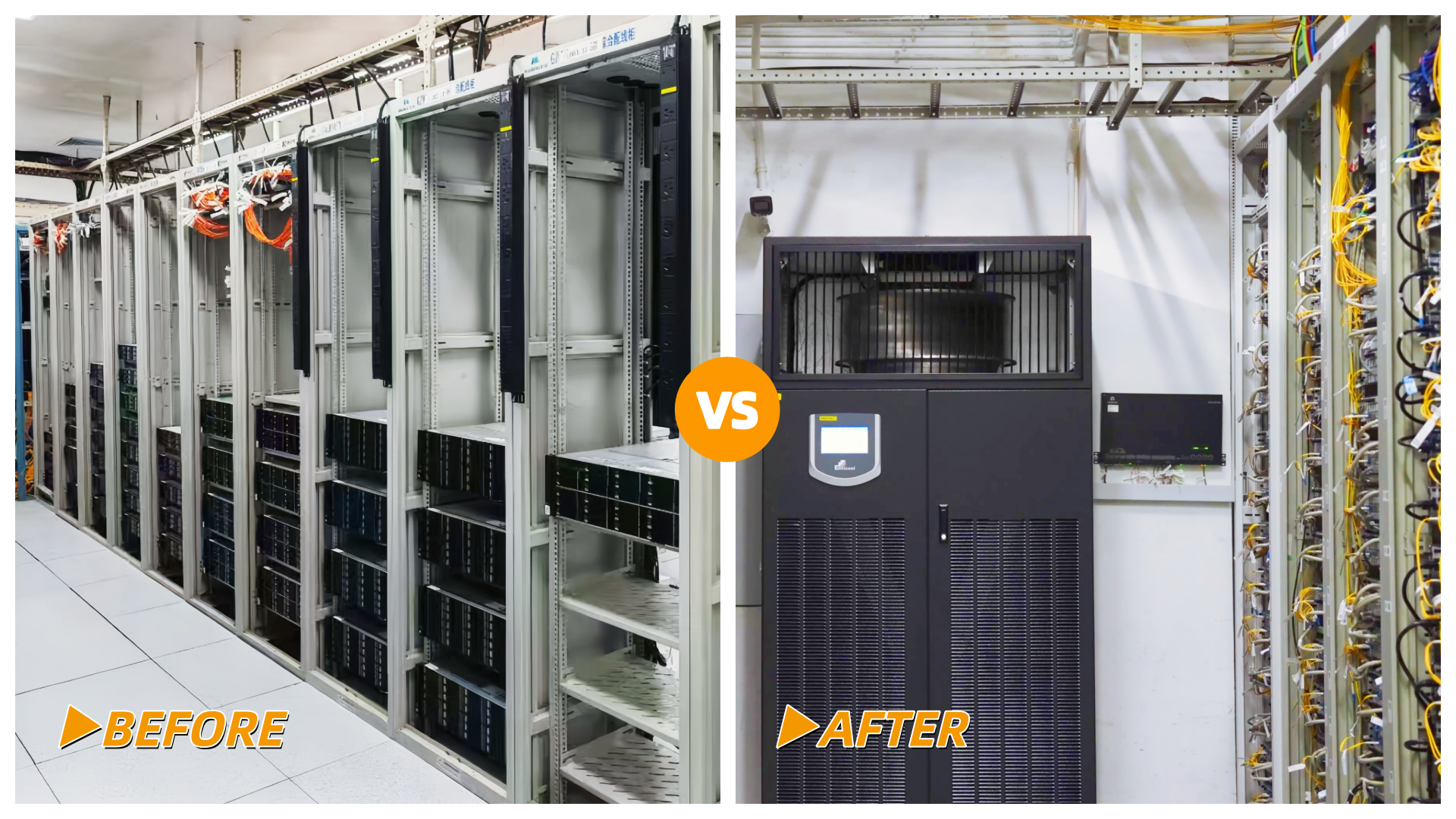
Systematic Retrofit: Pneumatic Heat Pipe + Cold Aisle Containment + AI Group Control
On the cooling source side, the application of XFreeCooling high-efficiency inverter pneumatic heat pipe technology enables the facility to prioritize natural cooling during transitional seasons, significantly reducing compressor runtime and transforming the cooling system into a significantly more energy-efficient operating model.
On the airflow side, cold aisle containment was implemented to reshape airflow distribution, clearly separating hot and cold zones and eliminating air mixing. This ensures that conditioned air is delivered directly to server rack inlets, maximizing the useful cooling capacity per unit of energy consumed.
On the control side, an AI-powered group control system continuously collects data from thousands of monitoring points, including rack temperatures, outdoor weather conditions, and IT loads. Using intelligent algorithms, it automatically calculates optimal supply air temperatures and fan speeds - enabling multiple air conditioning units to operate as a coordinated system rather than independently, dynamically matching cooling output to load and ambient conditions, and eliminating inefficient competition and redundant energy consumption.
Importantly, this retrofit was designed not only for energy savings but also with business reliability as the top priority. The facility must remain operational 24/7— any downtime is unacceptable.
To address this, Envicool worked closely with the customer to develop a phased implementation plan: pilot testing first, followed by batch rollout, with live-line operations and rolling switchovers at critical stages to ensure zero service interruption throughout the retrofit process.The project demonstrated that energy efficiency improvements can be achieved without compromising operational reliability or service continuity..
Measured Results: Significant Annual Energy Savings
Following the completion of the retrofit, the operational status of the TERimproved markedly: cooling performance became more balanced, temperature distribution became more uniform, and overall system stability further enhanced.
Measured results show that average annual PUE decreased substantially, with overall energy savings exceeding 40%. At current electricity rates, the retrofit cost is expected to be recovered in approximately three years, with continued energy savings and cost reductions in subsequent years -delivering both economic and environmental benefits through lower operating costs and reduced carbon emissions.
Key Success Factors: Customized Solution, Customer Collaboration and Zero Service Interruption
Moreover, this is not an isolated case. Throughout the project implementation, Envicool has developed a standardized retrofit process covering assessment, solution design, implementation, and commissioningwhich can be replicated and applied to energy-saving upgrades of other legacy facilities, transforming a single-site practice into a scalable methodology.
The Guangxi case demonstrates that the key to energy-efficient retrofitting of legacy data centers is not simply replacing equipment, but fundamentally rethinking and restructuring the system logic.
Through the integrated optimization of cooling sources, airflow management, and intelligent controls, it is possible to achieve both significant energy efficiency improvements and operational cost savings — while ensuring business continuity.

Look forward to your attention
This is our official account