Scan the QR code to follow us on WeChat.

We have provided
4000000
sets of ICT high-efficiency cooling and free cooling products to the world




Thank you for your interest
in our affiliated companies

This summer, extreme heat driven by the El Niño phenomenon put significant pressure on cooling systems in many data centers.
The air conditioners could start up normally, provide cooling, and meet all acceptance-test parameters. Yet once temperatures rose, the outdoor unit areas became increasingly hot, triggering frequent high-pressure alarms. In severe cases, some units even shut down completely. Now that temperatures are cooling, the problem may seem to have 'disappeared'. But without proper remediation, it could return next summer.
In mid-May this year, several units at a data center in North China experienced reduced heat-rejection capacity and even shutdowns. The customer urgently turned to Envicool with a clear requirement: resolve the outdoor-unit heat island issue as quickly as possible, without replacing equipment or interrupting operations.
Challenge: Extreme Heat Triggered Heat Islands and Unit Shutdowns
The data center is located in Huailai (a county in Zhangjiakou, Hebei Province, China), one of the hub nodes of China’s 'East Data West Computin' project. Despite being known as a summer resort, Huailai also experienced temperatures as high as 37°C this year amid widespread extreme heat across China.
After entering May, densely arranged equipment combined with high outdoor temperatures created a heat island effect around the outdoor units. Elevated inlet-air temperatures reduced the temperature difference available for heat exchange, significantly weakening heat-rejection capacity and causing some units to shut down.
If the retrofit could not be completed before temperatures peaked, the heat island effect would likely intensify, potentially expanding the scope of shutdowns. With only a limited window for effective intervention, the retrofit had to be implemented quickly.
Faced with the urgent requirement, Envicool responded quickly. Following on-site inspection and diagnosis, the service team delivered a preliminary solution within 24 hours.
The retrofit adopted a combined airflow-guiding hood + atomized spray cooling solution. Outdoor units were retrofitted in batches while keeping the existing air-conditioning structures and piping unchanged.
1. Airflow Guidance: Eliminating the Heat Island Effect
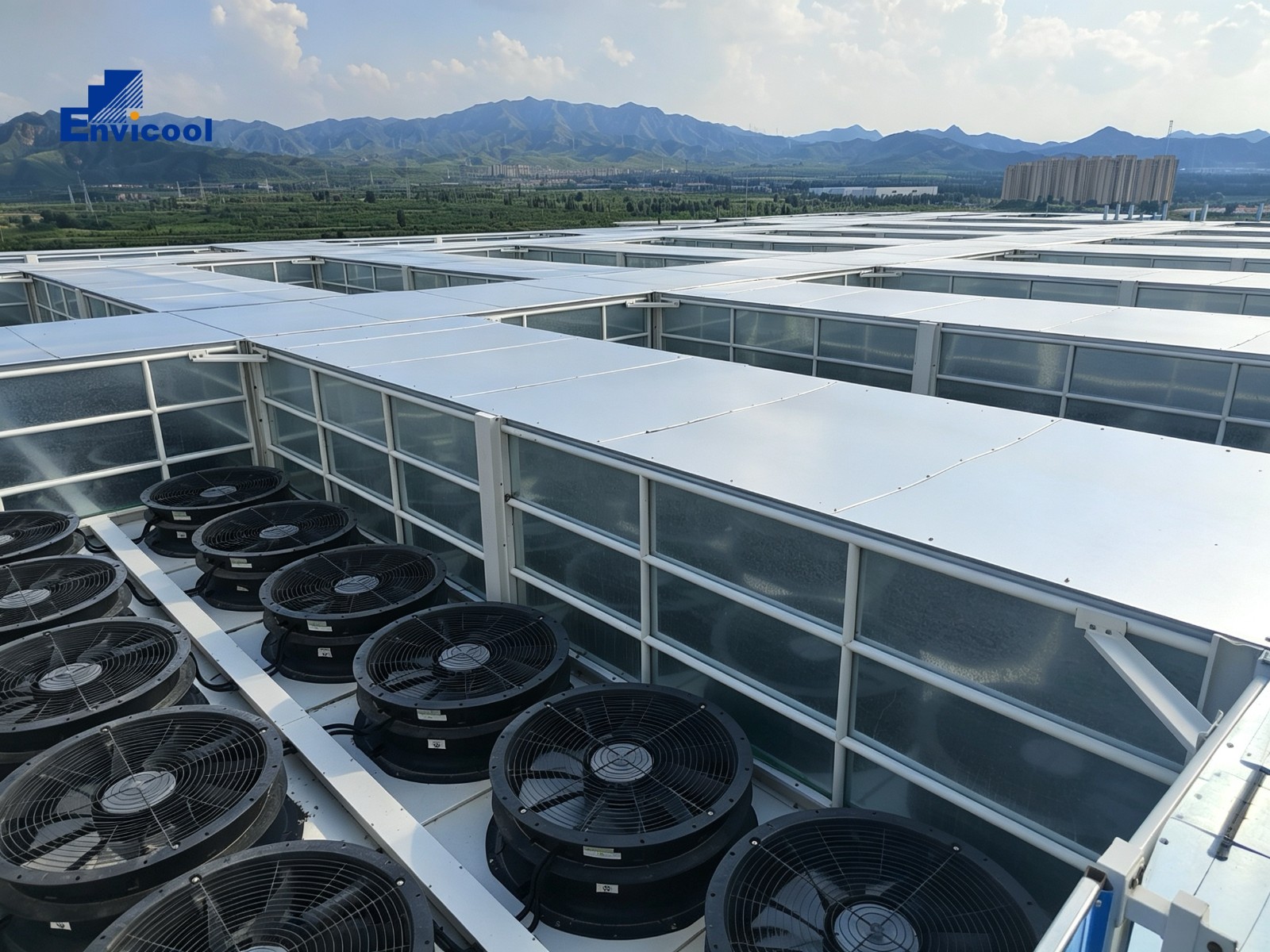
Envicool’s service team implemented a standardized retrofit across all outdoor units, installing airflow-guiding hoods on top of the units to direct hot air away in a controlled manner.
Additional sealing panels were installed to prevent hot air from recirculating through gaps and being drawn back into the units. The panels also reduced direct sunlight exposure to sensors, improving the stability of data collection.
After the retrofit, localized high temperatures caused by hot-air recirculation were significantly reduced, and condensing pressure returned to the normal range.
Building on the airflow optimization, Envicool installed an atomized spray cooling system along the ventilation corridors. By leveraging the heat absorption effect of water evaporation, the system lowers the air temperature entering the condensers.
As one Envicool field engineer explained: “The spray system was also designed to prepare for extreme conditions we may face in the future, such as high temperatures and high pressure.”
The system operates on an independent power supply and is completely decoupled from the existing air-conditioning system, so no shutdown of the original system is required.
More importantly, the system features an intelligent control module that automatically adjusts the spray volume according to ambient temperature and load conditions, without manual intervention.
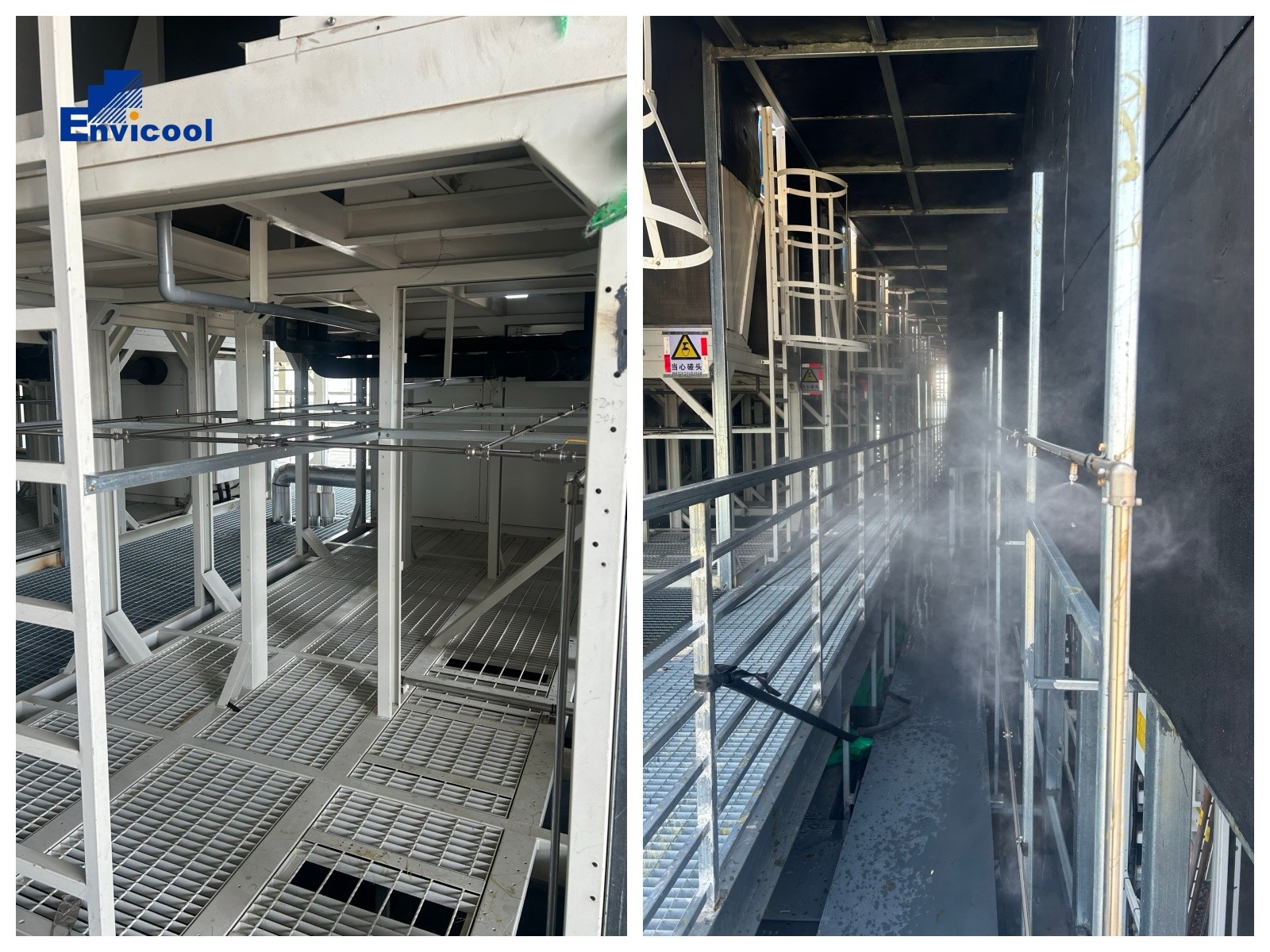
Atomized spray cooling installed along the ventilation corridor
Results: Delivered in 1.5 Months, Lowering Inlet-Air Temperature by More Than 8°C
From receiving the customer's request to completing deployment, Envicool’s service team completed the retrofit in just 1.5 months.
The construction was carried out in zones and focused exclusively on the outdoor units. The indoor units remained unaffected throughout the process, allowing business operations to continue without interruption.
“The results are quite good after the installation. The temperature reduction is very noticeable,” said the customer's on-site engineer.
After the retrofit, the air-conditioning inlet-air temperature dropped by more than 8°C, exceeding the customer's target of a 5°C reduction.
Data showed that the impact of the heat island was significantly reduced after the airflow-guiding hoods were installed, with condensing temperature decreasing by approximately 15°C compared with pre-retrofit conditions. The stability and energy efficiency of the cooling system were also significantly improved.
The customer’s on-site measurements showed an overall PUE reduction of 0.05, with annual electricity savings expected to reach RMB 1 million-level savings.
How can you determine whether a data center has a potential heat island issue?
Use a thermometer to measure both the outdoor unit’s inlet-air temperature and the ambient outdoor temperature. Then calculate the difference between the two:
Below 2°C: Good airflow organization and a safe heat-rejection environment.
2–3°C: Warning — the heat island effect has begun to impact heat-exchange efficiency.
Above 3°C: A localized heat island is likely present. High-pressure alarms or even shutdowns may occur during periods of extreme heat, requiring timely intervention.
If the measured temperature difference is high, or if the site has already experienced high-temperature alarms or rising PUE, the heat-rejection environment likely has room for optimization.
For such scenarios, Envicool’s cooling-source retrofit service provides targeted solutions:
No hardware replacement — Protect your investment. All retrofit work is performed on the outdoor-unit operating environment, without modifying the existing air-conditioning structure or piping.
Online retrofit — Zero business interruption. Only the outdoor areas are modified, while indoor units continue operating normally. Construction is carried out by zones to keep business operations running.
Rapid deployment — Respond when it matters. While similar retrofits in the industry typically take 2–3 months, Envicool can shorten the cycle to 1.5 months, with standardized processes covering solution confirmation, material shipment, and on-site team deployment to address urgent requirements.
No additional maintenance burden — Intelligent operation.The atomized spray system automatically starts and stops based on ambient temperature, with no additional routine maintenance workload.
If your data center has recently experienced extreme heat, heat island effects, or high-pressure alarms, now is a good time to address the issue while temperatures are lower and operational pressure is relatively light.

Look forward to your attention
This is our official account